Standard Tab Divider Sizes and Configurations
Binder dividers come in a small set of standardised page sizes and tab configurations. Knowing which combination fits the binder you’re using — and which tab count fits the way you’ll be filing — saves the wasted time of buying sheets that don’t match. The physical sizes haven’t changed in decades; what varies is the tab count, the tab cut, and the sheet brand.
Page sizes
Two page sizes cover almost all binder dividers in current use. US Letter dividers measure 8.5 × 11 inches, suit US three-ring binders, and pair with Letter-size pages. A4 dividers measure 210 × 297 mm, suit European and UK lever-arch and ring binders, and pair with A4 pages. The sheets are not interchangeable — A4 dividers don’t sit cleanly inside a US Letter binder, and Letter dividers protrude past the spine of an A4 binder.
Two further sizes appear in specialist contexts. Half-size dividers (5.5 × 8.5 inches or A5) match small ring binders for personal organisers, recipe binders and meeting notebooks. US Legal dividers (8.5 × 14 inches) match legal-size binders used in law firms and some accounting environments.
Tab counts
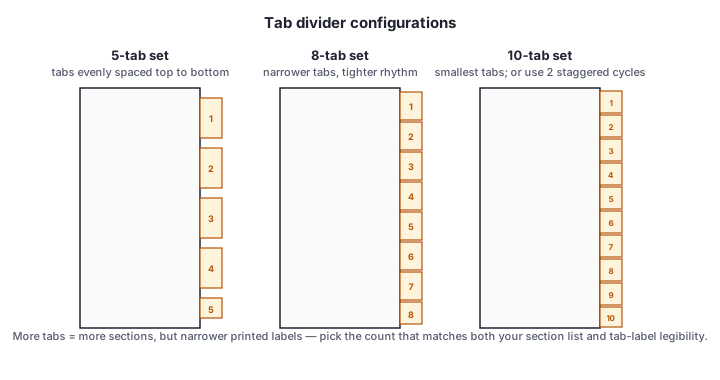
Tab count drives how the dividers cut up the binder. Common configurations:
| Tab count | Typical use |
|---|---|
| 5-tab | Office filing, project sections, simple subject dividers |
| 8-tab | Larger projects, course modules, multi-department files |
| 10-tab | Detailed project breakdowns, service category files |
| 12-tab | Monthly filing (one tab per month) |
| 15-tab | Bi-weekly filing or two-week sprint cycles |
| 26-tab | A-Z alphabetical filing |
| 31-tab | Daily filing (one tab per day of the month) |
A 5-tab divider set is the most common general-purpose option and is what most office filing defaults to. Move to 8-tab or 10-tab when subdivision matters — sub-categories within categories. Move to 26-tab or 31-tab only when the structure genuinely justifies it; over-divided binders are harder to scan, not easier.
Tab extensions
Tab extension refers to how far the tab sticks out from the body of the divider. Three cuts are standard: 1/2-inch, 1/3-inch, and 1/5-inch.
The 1/2-inch tab extension is the most generous — it’s what 5-tab and 8-tab dividers typically use, and it leaves room for longer labels. The 1/3-inch extension is common on larger sets where shorter labels keep the binder spine compact. The 1/5-inch extension is reserved for high-density tab counts (15 or more) where a wider tab would force the dividers into a fan shape that wouldn’t close inside the binder rings.
Bigger tabs are easier to grip and read; smaller tabs fit more sections into the same binder height. The choice is a trade between visibility and density.
Mapping sizes to Avery products
Avery’s product range covers most of the common configurations. The Insertable Tab series is the workhorse: 11423 is a 5-tab, 1/5-cut Letter-size set; 11428 is an 8-tab equivalent. The Big Tab range trades higher density for larger, more readable tabs — 11442 is a 5-tab Big Tab set with extended tab labels.
For pre-printed sets, 11820 is the Ready Index 1-31 monthly set, and 11816 is the Ready Index A-Z alphabetical set. Both sit inside standard US Letter binders.
If you’re choosing between configurations rather than products, how to create custom binder dividers covers the workflow from blank insert sheet to filled binder. For the full Avery product range and SKU-by-SKU breakdown, the Avery dividers guide lists every common configuration with its dimensions.